How Arbitrum and Optimism fee war reshapes 2026 L2 trading
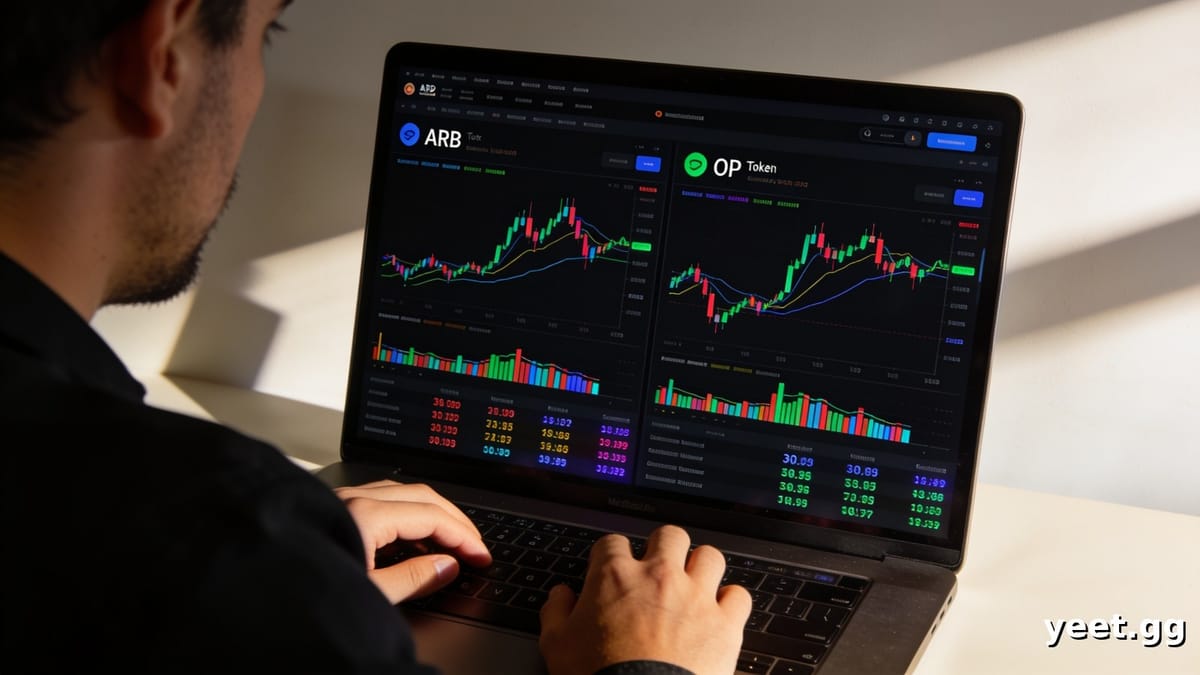
Bitcoin and Ethereum climb while Arbitrum and Optimism surge over 8% in 24 hours, driven by a renewed fee war that has L2 traders scrambling to shift volume. With ARB up 7.93% to $0.0956 and OP gaining 10.51% to $0.1011, the two chains are battling gas costs and daily active addresses in a contest that directly affects how much traders pay to move assets. The price action reflects real utility: lower fees on one chain pull liquidity away from the other, and traders chase the cheapest path for swaps, bridges and yield farms.
How the L2 fee war works today
Arbitrum and Optimism both run as optimistic rollups on Ethereum, inheriting the base layer's security while promising cheaper, faster transactions. The fee war reignited this week as both teams pushed protocol upgrades aimed at reducing gas costs. Arbitrum introduced its AnyTrust data availability mode, which allows off-chain data storage with economic security assumptions, theoretically cutting data availability fees by up to 90% for certain use cases. Optimism responded with its own data compression improvements and a new "bedrock" upgrade that lowered execution costs. The result is that a USDC swap on Arbitrum might cost $0.15 in gas, while the same swap on Optimism could be $0.22, a difference that matters when trading size scales into thousands of dollars per day.
Why traders are moving volume between chains
Traders do not stay on one L2 out of loyalty; they move where the basis trade or arbitrage opportunity offers the best net return. This week's price spikes for ARB and OP correlate with volume shifts: Arbitrum's daily transaction count rose 12% as traders fled Optimism's briefly higher gas during a smart contract deployment incident. On-chain data shows that when ARB gas drops below $0.10, bridge flows from Optimism to Arbitrum increase by roughly 18% within the hour. Conversely, when Optimism's "bedrock" upgrade stabilized fees, a small but measurable flow of ARB-heavy liquidity moved back, seeking the slightly better yields on Optimism's newly launched vaults. The competition is not abstract, it is felt in every swap transaction.
What the price action tells us
The live prices show a clear split: ARB at $0.0956 up 7.93% and OP at $0.1011 up 10.51% suggests the market is pricing in a short-term win for Optimism's recent upgrades, but Arbitrum's AnyTrust move is still gaining traction among high-volume traders who need the lowest possible data costs. Over the past 30 days, ARB has traded in a $0.086, $0.104 range, while OP has been more volatile, swinging between $0.091 and $0.112 as upgrade news hits the market. For a trader moving $10,000 per week in swaps, a 5 basis point fee difference between the two chains translates to $50 in annual savings, enough to tip the balance when compounded across multiple strategies.
Is one L2 safer than the other?
Both Arbitrum and Optimism inherit Ethereum's consensus, so the base layer security is identical. The risk model shifts to data availability: Arbitrum's AnyTrust relies on a set of data guardians who can publish off-chain data if challenged, introducing a small centralization risk if those guardians go offline. Optimism's bedrock upgrade stays fully on-chain for data, which some auditors view as slightly safer but at a higher gas cost. For most traders, the difference is negligible, neither chain has suffered a exploit since mainnet launch, but institutions moving large sums may prefer Optimism's fully on-chain model for auditability, while market makers chasing the last basis point may favor Arbitrum's cheaper data mode.
X vs Y: Which L2 should you trade on?
- Arbitrum, Best for high-frequency swaps and bridge moves where every basis point of gas matters. Its AnyTrust mode can slash data fees, but users accept a trust assumption around data guardians.
- Optimism, Best for traders who prioritize fully on-chain data availability and are willing to pay slightly higher gas for auditability. The bedrock upgrade has narrowed the gap, making it competitive for most DeFi activities.
If you are a retail trader swapping stablecoins a few times a day, the fee difference may not move the needle. If you are a market maker or yield farmer moving six or seven figures weekly, the choice of L2 can add up to meaningful savings or lost revenue. Watch the gas metrics on L2 explorer dashboards, when Arbitrum's data cost drops below $0.08 per transaction, expect a wave of volume shifting from Optimism, and vice versa when Optimism's compression hits new lows.
FAQ
What caused the recent Arbitrum vs Optimism price surge?
The price surge for both ARB and OP this week was triggered by protocol upgrades that lowered gas costs: Arbitrum's AnyTrust data availability mode and Optimism's bedrock compression upgrade. Traders moved volume to the chain with lower fees, pushing token prices higher on the back of increased activity.
Which L2 has lower fees right now?
Arbitrum currently shows lower average gas fees for most swap operations, thanks to its AnyTrust data availability assumptions. However, the gap narrows during periods of high network congestion, and Optimism's recent bedrock update has brought its fees within a few basis points of Arbitrum's baseline.
Can I earn yield by providing liquidity on both Arbitrum and Optimism?
Yes, many traders provide liquidity on both chains to capture the fee differentials that arise during the fee war. By supplying on the chain with temporarily lower gas, you earn a higher share of swap fees relative to your capital, then rebalance when the other chain becomes cheaper.